
Knee Brace
Overview
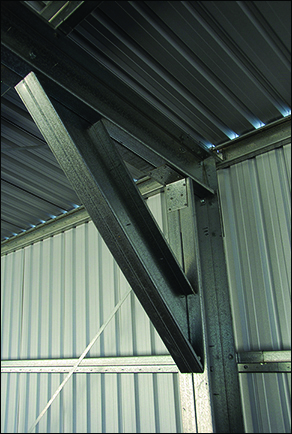
Knee bracing is a critical structural component within a building’s engineering design.
Knee braces function by:
Reducing the effective length of the column top and lower rafter.
Strengthening the haunch connection, where the column meets the rafter.
Reducing axial torque at the column top.
Each brace forms a balanced, equal-angle support that contributes to the overall rigidity of the building.
Why this is important
Provides lateral stability and structural strength at key junctions.
Reduces torque and deflection in the portal frame.
Improves overall engineering performance and building longevity.
Knee brace options
In SMS, there are three selectable knee brace options:
1. Full knee brace
This is the default starting option for most building designs.
Provides the best engineering solution and maximum stability.
The length of the knee brace is listed on the Quote Letter and in General Notes, where the minimum knee brace clearance is also displayed.
2. Reduced knee brace
Offers more clearance below the knee brace by increasing the angle between the column and the rafter.
May result in a larger portal frame size to meet engineering requirements.
Commonly used where internal clearance or machinery height is a concern.
3. None (no knee brace)
SMS will attempt to generate a design without knee braces.
This option is highly limited and only available under specific design conditions.
-
If a calculation is successful without knee braces, users should:
Check the Bill of Materials (BOM) carefully to confirm knee braces are not included.
Review the Specifications page to ensure compliance.
Skillion roof designs will always include knee braces and cannot be configured without them.
Tips, best practices & troubleshooting
Always review the BOM and General Notes after calculation to confirm brace details.
Select Reduced Knee Brace for designs requiring additional internal clearance.
Avoid using the None option unless verified by engineering, as it may lead to instability.
For custom configurations, contact Design Help to ensure structural integrity.
Related resources
Review & updates
Version history:
v1.0 – 19 April 2025
v2.0 – 6 October 2025
Article information
Category: Estimation View & Shed Design
Target audience: Estimators, SMS users, and design teams
Business owner:
Version: v2.0
Last reviewed: 6 October 2025