
Wind Region A
Overview
Region A wind classifications are based on AS 1170 standards. Regional wind speeds (Vr) in this region range from 41 m/s (147.6 km/h) for Importance Level 1 (IL1) to 48 m/s (172.8 km/h) for Importance Level 4 (IL4).
Why this is important
Determines correct regional wind speeds for safe and compliant building design.
Ensures quotes and designs meet ShedSafe and Australian Standards requirements.
Prevents misclassification errors that can lead to under- or over-engineered structures.
Wind Region A sub-categories
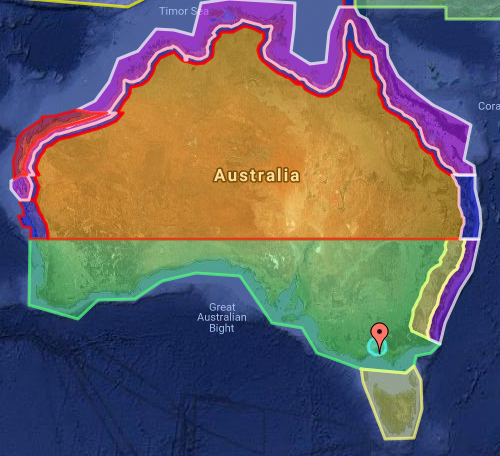
Region A is divided into five categories, depending on the building location:
Region A1 – Covers the majority of NSW, VIC, and parts of WA and SA, extending from Green Head WA across SA to Bundarra in NSW where Region A1 meets A3. Below this line is Region A1.
Region A2 – Extends from Coffs Harbour to the Victoria border and 50 km inland from the smooth coastline.
Region A3 – Outlined by Kookabooka to the Victorian border, including part of Kosciuszko National Park, from 50 km to 100 km inland from the smooth coastline. Region A3 is also the nominated wind region for all of Tasmania.
Region A4 – The largest wind region in Australia, covering the majority of WA, NT, and QLD. Starts at the A1 line and includes all remaining areas except within 200 km of the smooth coastline.
Region A5 – Covers a small circular region around Melbourne and outer suburbs. This includes Shoreham east to Warburton, north to Broadford, west to Ballan, and down to Geelong.
Snow loads within Wind Region A
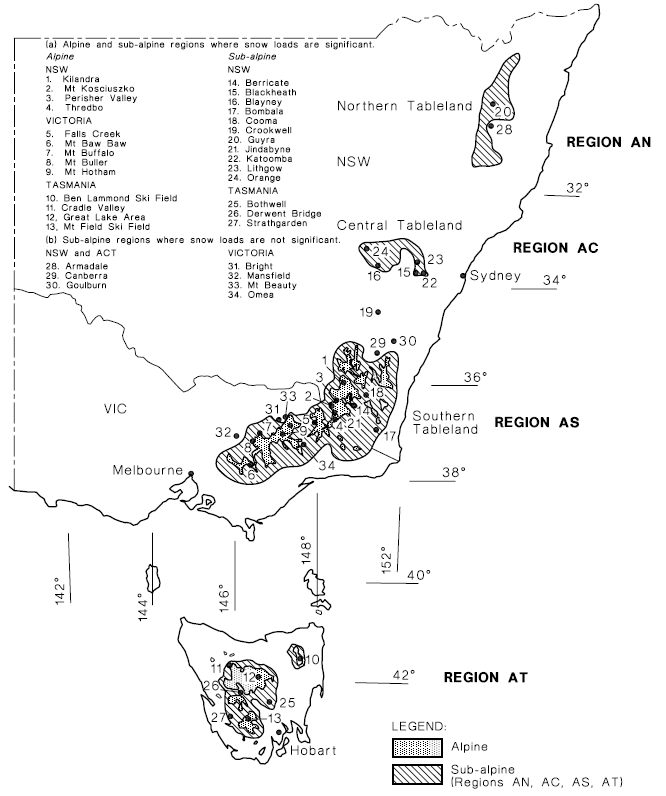
Snow loading is present in Wind Region A. Alpine and sub-alpine regions are defined as follows:
Australian Northern (AN): Northern Tablelands, NSW – Sub-alpine at altitudes above 600 m.
Australian Central (AC): Central Tablelands, NSW – Sub-alpine at altitudes above 600 m.
Australian Southern (AS): Southern Tablelands, NSW – Sub-alpine between 600 m and 1200 m, Alpine ≥1200 m.
Australian Tasmania (AT): Tasmania – Sub-alpine between 300 m and 900 m, Alpine ≥900 m.
⚠️ SteelX only designs buildings to be built in Sub-Alpine regions.
Tips, best practices & troubleshooting
Ensure the site is pinned correctly in SMS to determine the correct wind sub-category.
When designing for Tasmania, remember the entire state falls under Region A3.
For alpine classifications, confirm site elevation before quoting or designing.
Related resources
Request Engineering (Site Check)
Review & updates
Version history:
v1.0 –
v2.0 – 22 August 2025
Article information
Category: Engineering & Site Specifications
Target audience: Estimators, Sales Coordinators, Franchise Users
Business owner:
Version: v2.0
Last reviewed: 22 August 2025