
Wind Directional Multipliers (MD)
Overview
Wind Directional Multipliers (MD) are used in structural design to account for the varying severity of thunderstorms depending on their direction.
The simplified explanation is that a design wind event will be the result of thunderstorms, and the areas nominated as “1” represent the direction of the most severe thunderstorms. This multiplier allows for a reduction in other directions based on the relative severity of storms from those directions.
Why this is important
Ensures that structures are designed safely by accounting for wind direction severity.
Prevents over- or under-engineering by applying the correct multipliers.
Aligns with Australian Standards (AS 1170) requirements for wind design.
Wind directional multiplier factors by region
The wind directional multipliers for each region are:
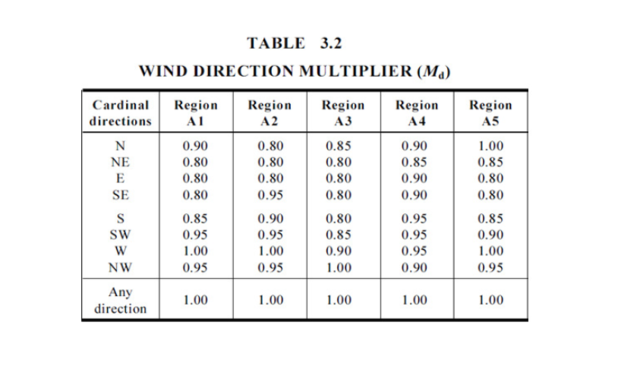
Region A: Between 0.8 and 1 (Refer to Table 3.2 in AS 1170).
Region B: 0.95 in all directions.
Region C: 0.95 in all directions.
Region D: 0.95 in all directions.
Tips, best practices & troubleshooting
Always check SMS for the assigned region to ensure the correct multiplier is applied.
For Region A, confirm which value between 0.8 and 1 applies, as it varies depending on location and direction.
When in doubt, consult AS 1170 Table 3.2 for verification.
Related resources
Request Engineering (Site Check)
Review & updates
Version history:
v1.0 –
v2.0 – 22 August 2025
Article information
Category: Engineering & Site Specifications
Target audience: Estimators, Sales Coordinators, Franchise Users
Business owner:
Version: v2.0
Last reviewed: 22 August 2025